Resilience for Technology Service Providers
Your customers count on you to stay available, and that trust takes years to earn and minutes to lose. Fusion gives technology and service providers a live picture of the services, systems, and third parties behind every customer commitment, so the moment something goes wrong, you can see what is affected and decide what to bring back first.
4.4/5 Star Rating on G2
Leader in BCM
BCI World Hall of Fame
4.5/5 Star Rating on Capterra
Why Resilience Is Different For Technology and Service Providers
For a technology or service provider, uptime is the product. A degraded service rarely stays an internal problem for long. It lands on the customers who depend on you, and on the promises written into their contracts.
Three things make resilience harder in this sector than in most:
- Your obligations are contractual. Every hour of downtime carries a service-level penalty and a renewal conversation.
- Your dependencies are shared. Multi-tenant and cloud infrastructure, and a deep bench of third parties mean a single upstream failure can cascade across many customers at once.
- Your reputation is your pipeline. A visible outage costs you trust with prospects as well as existing customers.
For a service provider, availability is the business itself.
Connect to Any Underlying Business System with Fusion’s Platform
Leverage a complete set of AI-enabled automation tools to boost efficiency, enhance transparency, and strengthen your resilience capabilities. Request a free demo to see how Fusion can transform your operations.

What Is Technology Resilience?
Technology resilience is the ability to keep technology-dependent services running through disruption and to recover them in the right order when they fail. That goes beyond uptime engineering and beyond disaster recovery. The real work is knowing which services matter most to your customers, then being able to protect and restore them while everything is under pressure.
Three terms get tangled together here. IT disaster recovery is how you bring technology back after a failure. Operational resilience is the discipline of protecting the services customers actually use, and in many markets, regulators now expect it. Technology resilience sits across both and governs a harder question: when you cannot save everything at once, what do you protect and restore first?
Backup belongs in a different category. Backup and failover protect your data and infrastructure, and you need them. Technology resilience is the layer above that decides, in the moment, which customer commitments come first and in what order. Fusion treats that as a decision problem, grounded in a continuously maintained model of how your services actually work.
Technology resilience, IT disaster recovery, and backup are related but distinct. The table below shows where each one fits.
| Backup and failover | IT disaster recovery | Technology resilience | |
|---|---|---|---|
| Protects | Data and infrastructure | System recovery | Customer-facing services |
| Key question | Is the data safe? | Can we bring it back? | What do we restore first? |
| When it acts | Continuously, in the background | After a failure | Before, during, and after |
| Fusion’s role | Complements it | Connects to it | The decision layer above both |
How To Choose a Technology Resilience Platform
A good platform does more than tell you something broke. It tells you what is affected, what is likely to follow, and what to restore first, all tied to the customer commitments that matter most. The criteria below work for evaluating any provider, Fusion included.
| What to look for | Why it matters for service providers |
|---|---|
| A live service-and-dependency model |
Alerts tell you something failed. A dependency model tells you which customers and services are affected and what will cascade next, which is a challenging task to accomplish manually under pressure. |
| Works with the systems you already run |
Resilience should sit on top of your monitoring, cloud, and ITSM stack, as well as your recovery tools. Ask how a platform integrates, not what it rips out. |
| Recovery sequencing tied to your SLAs |
With several services down at once, the platform should help you restore the most critical customer commitments first, under real constraints, rather than work a static checklist. |
| Scenario testing against your own data |
Readiness you have not tested is a hope. Look for the ability to model severe but plausible events against your actual environment. |
| One governed model, not a stack of point tools |
The blind spots in an outage live in the gaps between separate alerting, ticketing, and planning tools. A single model removes those gaps. |
| Coverage across IT and operational technology |
Providers with physical or operational footprints need both technology and operational dependencies in the same picture. |
Technology Resilience Is The Capability. Enterprise Resilience Is The System.
During a disruption, technology resilience has to answer four questions at decision speed: what is impacted, what happens next, what is the financial exposure, and what to prioritize. Fusion answers them from a single, governed service-and-dependency model that connects your services to the processes, applications, technology, people, and third parties behind them.
That same model is the foundation of your wider enterprise resilience program. It connects technology resilience with business continuity, IT disaster recovery, crisis and incident management, and third-party risk management, so every team works from one shared picture instead of its own. Scenario Testing runs scenario variations against that model using your own data, so what you learn reflects your environment and not a generic template.
See the wider market picture in The Enterprise Resilience Report.
Case Study
When you multiply the time savings [Fusion gave us] over our network of sites, it adds up to multiple hundreds of hours saved.
Aureon
See it in practice. Aureon, a technology and data services provider, runs Fusion across its network of sites and credits it with saving hundreds of hours. Read the Aureon case study.
Keep Your Services Up And Running
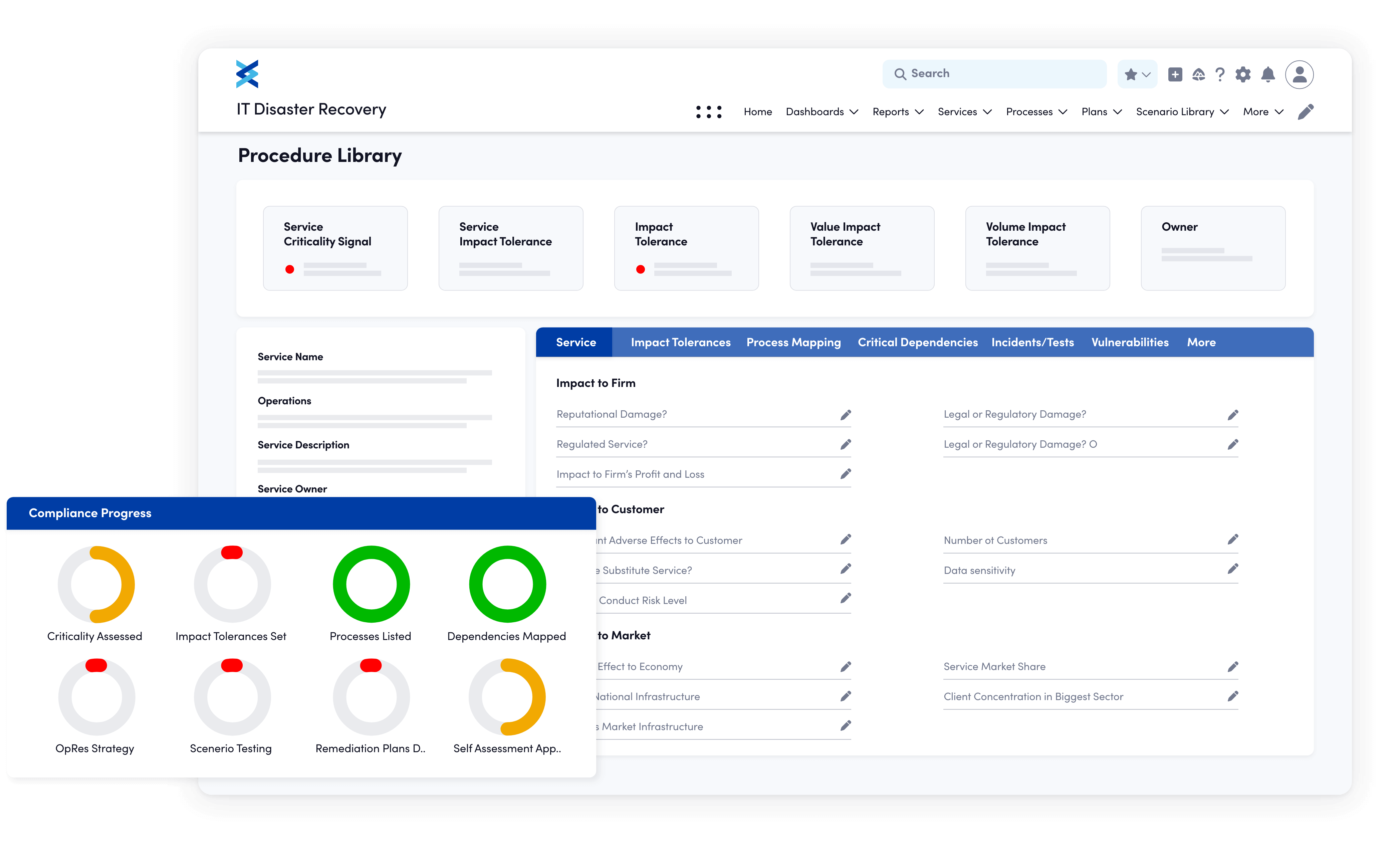
Fusion gives you the context to understand every dependency behind a service before it fails. It maps the relationships across your services, people, third parties, applications, systems, data, property, processes, and geography, so you can find single points of failure and build response plans that match how your environment actually works.
Learn More

Turn Static Plans Into Living Data
Plans go stale the moment they are written. Fusion’s BC Plan inFusion capability converts the plans and systems you use today into structured, current data rapidly, so your team works from an accurate picture rather than a document that was true last quarter.
Find Out More

Recover The Right Services First, Under Your SLAs
In a real outage, several services go down together, and recovery becomes a sequencing problem. Which customer commitment comes back first? Fusion’s Recovery Optimization works out an optimized recovery sequence under your real constraints, so you protect the most critical commitments first instead of working a fixed list.
Find Out More
Turn Compliance Into A Strategic Advantage
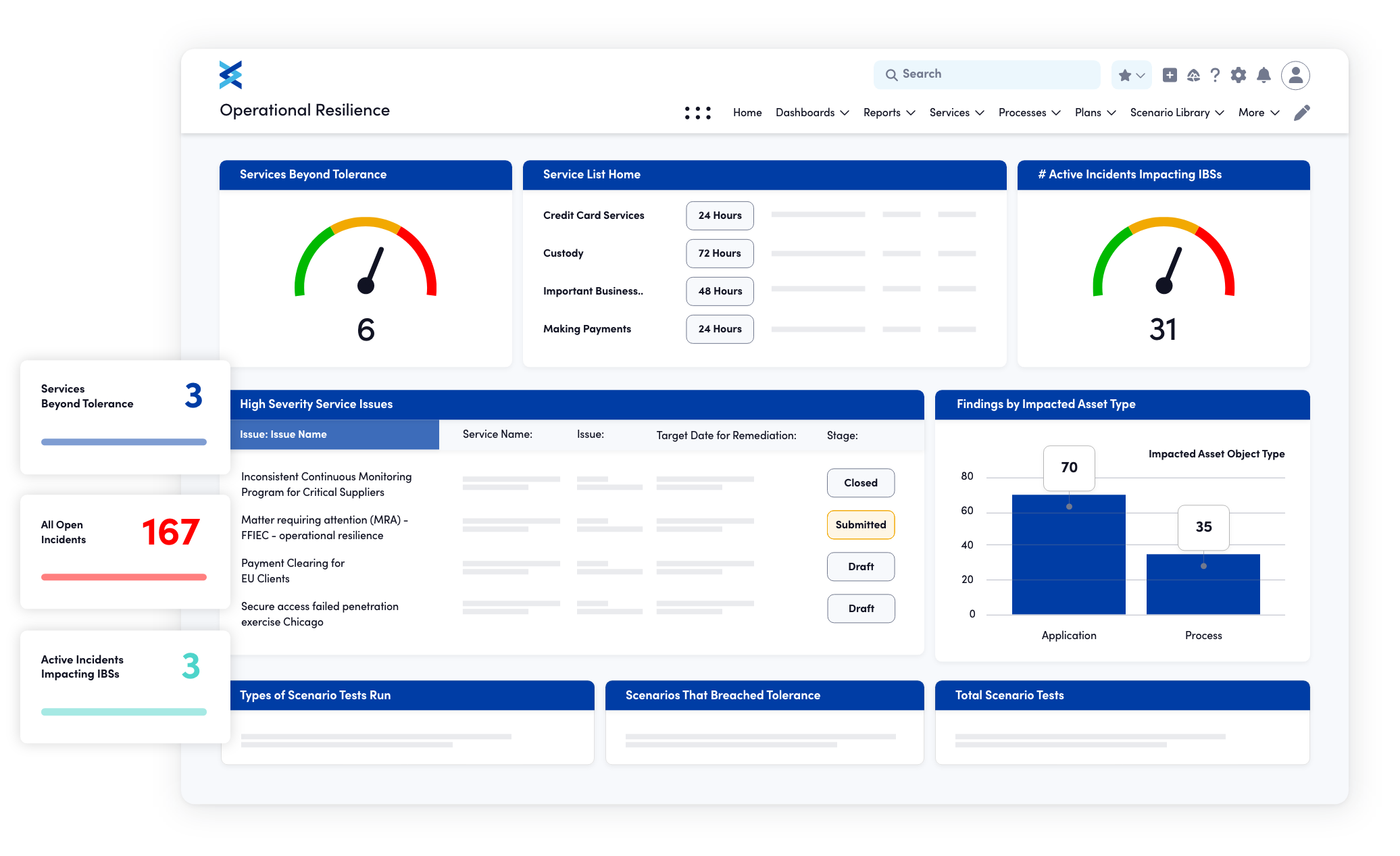
Most resilience regulations, including the Digital Operational Resilience Act (DORA), are really after one thing: resilience you can prove. Even where no specific rule applies to you, that is the bar worth clearing. Fusion makes it easier with streamlined reporting and current data, so showing your resilience to regulators, auditors, and your own customers becomes a byproduct of running the program rather than a separate project.
Learn More
Test Against The Disruptions That Would Hurt Your Customers Most
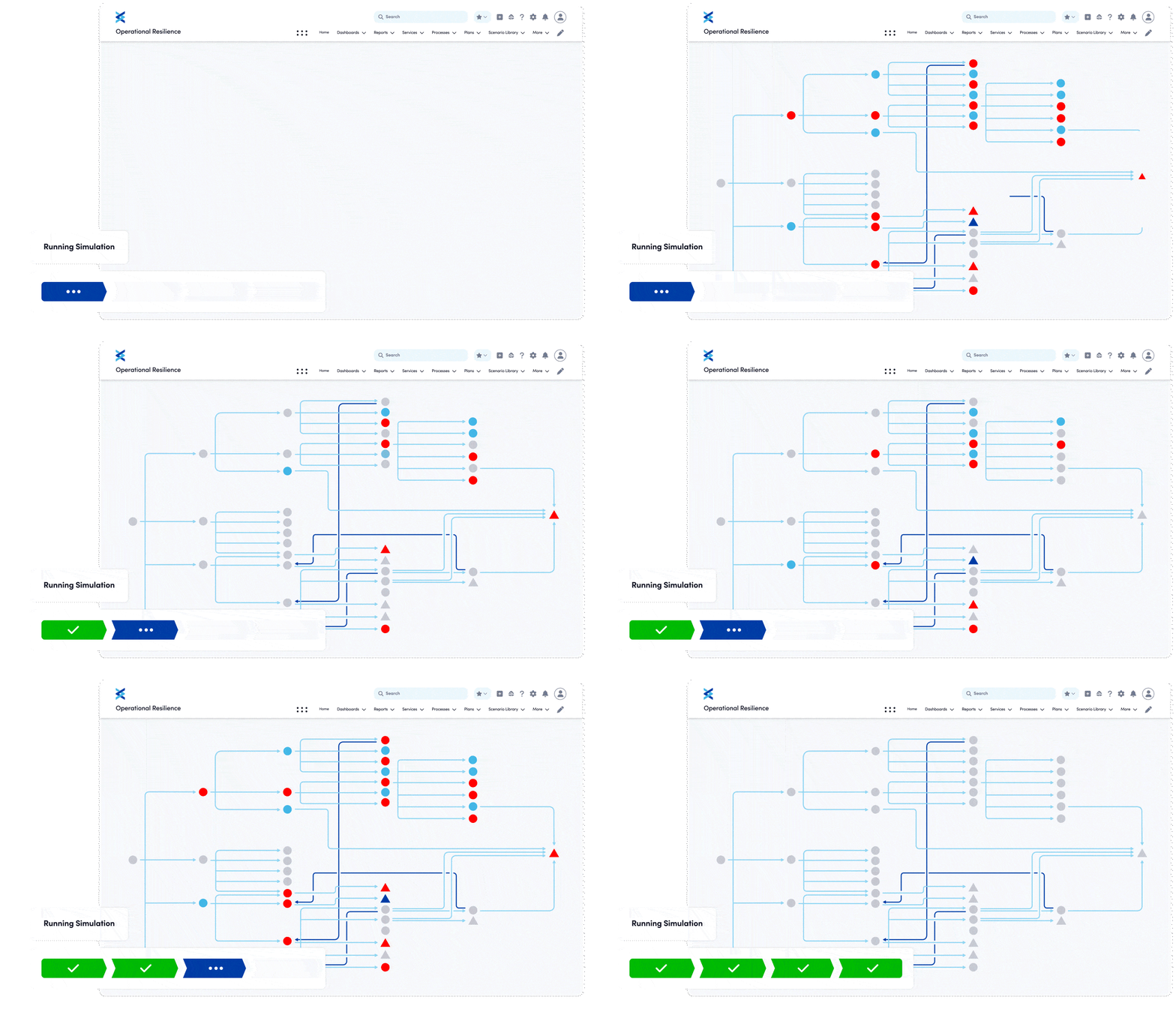
You will not prevent every disruption. What you can control is how ready you are for the ones that would actually hurt. With Fusion’s Scenario Testing, your team can run many variations of a disruption against your own data, find the vulnerabilities that would reach your customers, and pinpoint the steps to close them. See how AI improves scenario development and testing.
Find Out More
Frequently Asked Questions
Start from the customer commitment, not the feature list. Look for a live service-and-dependency model that shows what is affected and what to restore first, integration with the systems you already run, recovery sequencing tied to your SLAs, and scenario testing against your own data. Fusion is built around those criteria, with one governed model rather than a stack of disconnected tools.
Yes. Fusion is designed to sit on top of your existing monitoring, cloud, ITSM, and recovery tools through its integrations, adding a decision layer rather than replacing the stack you depend on.
No. Backup and failover tools protect your data and infrastructure, and they remain essential. Fusion is the decision layer above them, working out which services and customer commitments to protect and restore first, and in what order, when you cannot protect everything at once.
IT disaster recovery brings technology back after a failure. Technology resilience is the broader practice of knowing which services matter most and being able to protect and restore them in priority order. Fusion connects the two through one dependency model. Learn more on the IT Disaster Recovery page.
Service providers carry resilience risk across shared and multi-tenant infrastructure and a deep web of third parties. Fusion maps those dependencies to the customer-facing services they support, so you can see how an upstream failure spreads across your customer base and respond in the order that protects your commitments first.
Build Resilience That Your Customers Can Count On
See how Fusion helps technology and service providers protect the uptime and trust their customers depend on.