
Key Takeaways:
- Complexity is accelerating across the business landscape. As systems grow more interconnected, AI adoption skyrockets, and regulations become more complicated, businesses that are not consistently working toward enterprise resilience risk being left behind.
- Static tools and documentation are no longer enough. Instead of consigning continuity efforts to an isolated program, organizations must fully integrate their data and coordinate across departments to achieve a holistic, proactive stance toward managing threats.
- Organizations’ resilience efforts fall along a maturity curve, and the gap between reactive and proactive companies is widening rapidly. Businesses that invest in integration, automation, and AI-driven insight will remain dominant, while those that rely on siloed, static systems will lose relevance and market share.
The scope of resilience has expanded significantly over the past decade. What began as business continuity management now spans every function of an organization, and the expectations placed on resilience programs have grown accordingly. Organizations that take a proactive approach to building operational resiliency are quickly outpacing those that simply react to the latest threats.
Business continuity management remains at the foundation of a successful approach to resilience. However, over the past decade, the scope of resilience has expanded to include every department in an organization. Now, the goal must be enterprise resilience: an agile, holistic approach to risk that allows businesses to make more informed decisions not just about continuity, but about strategy and performance as well.
The first step toward enterprise resilience is better understanding how far your organization needs to go in order to achieve it. Fusion’s Enterprise Resilience Index assessment can help you benchmark your business’s current maturity level. If you notice room for improvement, we are here to help. Fusion’s innovative enterprise resilience solutions can help your organization achieve its goals.
Traditional Continuity Efforts Fall Short of True Resilience
In today’s volatile economic environment, traditional continuity plans often fall short. Their mandate, the creation of a business continuity program, is simply too narrow to transform the culture of an entire organization. True enterprise resilience demands extensive coordination from every department and every team, from IT to operational resilience to HR.
The Main Forces Reshaping the Resilience Landscape:
- AI is accelerating across enterprise operations. AI promises to make all types of corporate work more efficient, scalable, and impactful if organizations can harness it effectively. Business leaders want to know that their existing resilience investments are delivering measurable results, and they feel pressure to scale up with AI.
- Organizations are becoming increasingly reliant on SaaS and complex third-party ecosystems. As commerce grows increasingly digital, businesses are more interconnected than ever. It is difficult, if not impossible, to maintain a competitive advantage without depending on a complex web of cloud-based applications and third-party vendors, all of which are subject to their own risks.
- Cross-border regulations, led by frameworks like DORA, necessitate a culture of compliance. Every industry is subject to regulations that aim to safeguard stakeholders, like the EU’s DORA (Digital Operational Resilience Act). Complying with these complex regulations requires careful planning, extensive coordination, and comprehensive documentation.
- Board-level disclosure requirements and governance scrutiny add to organizational pressure. While resilience teams are focused on maintaining continuity in the face of risk, board members and executives are focused on the bottom line. The pressure on resilience leaders to deliver measurable results as efficiently as possible has never been greater.
As the corporate landscape shifts, there is a growing need to define what enterprise resilience really looks like today. That’s why Fusion has spent the past five years studying the resilience needs of organizations worldwide.
Over the course of 4,571 structured conversations with representatives from 1,765 global organizations, Fusion has learned precisely how businesses transform their approach to resilience from reactive and fragmented to confident and prepared.
Though our participant organizations represent a wide variety of industries, markets, and maturity levels, their resilience efforts all fell somewhere on our Enterprise Resilience Index.
Introducing the Fusion Enterprise Resilience Index
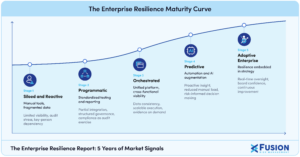
At Fusion, we know that resilience isn’t a luxury: it’s key to remaining competitive in treacherous times.
The maturity gap between organizations with ad hoc or limited resilience programs and those that have embraced enterprise resilience is growing fast. Our Enterprise Resilience Index demonstrates how that gap can be resolved.
Stage 1: Siloed
An organization at Stage 1 has resilience activities underway, but they are fragmented across teams, tool, and processes. Any processes or controls in place to manage disruptions are likely siloed and dependent on the intervention of one or two key employees.
Data is likely fragmented, and any action plans that exist may be tucked away in static documents and disconnected tools. This makes it impossible for many members of the organization to see the bigger picture. Documentation is limited or nonexistent, which leads to major compliance challenges.
What It Looks Like When Your Team Still Relies on Manual Tools
Manual business continuity planning that relies on static documents, shared drives, and ad hoc spreadsheets used to be the only game in town. Leaders who have inherited these static systems sometimes hesitate to invest in dynamic tools.
However, a robust resilience program is no longer optional. Thanks to both domestic and international regulations, your organization’s resilience efforts must be publicly disclosed. Boards need to see that the organization is relying on far more than eleventh-hour heroics to navigate through rough waters.
When it comes time for regulatory reviews and audits, organizations that rely on manual tools struggle to demonstrate true preparedness. Documentation may exist, but it cannot answer the questions that matter under real pressure — what is impacted, what is the financial exposure, and what should be prioritized.
Read our From Plans to Performance whitepaper to learn how to build business continuity that works when it matters most.
Stage 2: Programmatic
A Stage 2 organization has established processes to manage risk, often within the context of a business continuity program. Leadership is aware of top risks, and a continuity team has begun to adopt action plans for those threats that pose the clearest danger to the business. From most perspectives, resilience plans in this stage appear complete, that is, until disruption strikes.
Even as the organization begins its journey toward integration, issues still remain. Dependency mapping is incomplete and cross-functional coordination under pressure remains largely untested. While compliance is more streamlined, it remains a theoretical exercise rather than being quantified as capital at risk.
What It Looks Like When Visibility and Compliance Gaps Are Not Improving
Despite their business continuity efforts, many companies stall out at Stage 2 because of a perception gap, not a program gap. Plans pass audits, BIAs are completed, and annual exercises run on schedule; all of which produce justified confidence. But that confidence is calibrated to a compliance standard, not to operational reality under disruption. The program appears complete until a real event reveals what tabletop exercises were never designed to find.
A formal resilience program is a great place to start, but progressing to a point where programs are prepared for operational realities under disruption, not just meeting compliance standards, requires consistent messaging from leadership and accountability across the company hierarchy.
Stage 3: Orchestrated
Once a business reaches Stage 3, the fog begins to clear. Thanks to a unified platform that integrates all or most of an organization’s pertinent data, every department can finally evaluate the risk landscape and demonstrate evidence of compliance.
Business continuity initiatives are no longer top-down affairs; now, many different teams collaborate on activities like scenario testing. Additionally, cross-functional escalation paths are tested under realistic conditions, and investment decisions begin to be driven by actual exposure data rather than annual budget cycles.
What It Looks Like When Integration, Not Automation, Is the Top Priority
Until recently, our participants cited integration and consolidation as their top resilience priorities. Integration is certainly key to reaching Stage 3 of the Enterprise Resilience Index, but with the rise of AI, it is no longer enough. Leaders are now under immense pressure to get value out of their integrated systems without increasing costs.
Automating previously manual tasks reduces dependency on any one individual and allows teams to focus on higher-level tasks. It also allows organizations to scale compliance efforts, testing, and data collection. This leap forward is what allows organizations to move from understanding risk to predicting it.
Stage 4: Predictive
In Stage 4, businesses have learned to automate once-onerous tasks, freeing teams to focus on interpreting data and finding creative resilience solutions. Recovery objectives are no longer set by the BIA process alone; they are dynamically tied to impact tolerance models and risk-adjusted capital allocation, allowing the CRO and CFO to answer financial exposure questions with quantified precision. Decisions are guided by modeled risk and business impact, with the resilience approach centered around being forward-thinking instead of simply proactive.
A unified, AI-powered platform like Fusion provides the whole organization with deep insight into risk, allowing leaders to make informed, data-driven decisions. Because teams are no longer constantly putting out fires, the organization’s approach to business continuity becomes far more flexible and adaptive.
Still, there is room for improvement. While business continuity initiatives are now a key part of organizational culture, some minor disconnects may remain between those efforts and becoming overarching enterprise objectives.
What It Looks Like When Maturity is Accelerating in Other Regions
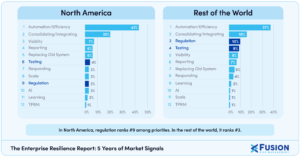
Even the most resilient enterprises must keep up with regulations. While respondents worldwide cited automation and integration as their top resilience goals, there is a significant gap between North American companies and those in the rest of the world when it comes to prioritizing regulation and testing.
Regulation is a growing global expectation. Waiting to invest in compliance until new mandates appear can create significant financial and governance risk.
Stage 5: Adaptive Enterprise
Stage 5 is the goal every organization should be working toward. In Stage 5, every department and team regularly uses the organization’s fully integrated, enterprise resilience framework to gain real-time insight into current conditions and future risks that inform daily decision-making. Resilience is not just a program, but an embedded enterprise strategy that continuously adapts in real time.
What truly distinguishes Stage 5 from Stage 4 is continuous optimization. Recovery objectives are dynamically recalibrated against live operational data, AI-assisted scenario generation and reporting operate at scale, and the resilience infrastructure itself becomes a strategic asset that compounds in value over time.
In a Stage 5 organization, executives and department leaders alike use enterprise resilience insights to shape company-wide strategy. They understand that, in today’s world, a successful business is a resilient business.
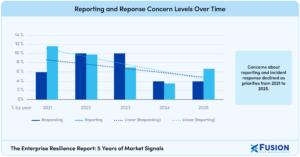
What It Looks Like When Reporting and Response Concerns Have Quieted
Over the past five years, most organizations that have successfully moved up the maturity curve have reported less concern about how they respond to threats, document their resilience efforts, and report the results to boards and regulatory bodies. Action plans and reporting procedures are becoming standardized, and leadership is beginning to act with confidence.
However, it’s important to avoid complacency. As technology progresses and novel risks appear, old playbooks may fall out of date. To ascend to Stage 5, true enterprise resilience, businesses must continually prepare for novel threats like SaaS outages, geopolitical threats to supply chains, and incidents involving AI.
Five Years of Data Expose a Widening Enterprise Maturity Gap
Fusion’s five years of conversations with business leaders have identified a growing gap between organizations that invest in automated, integrated enterprise resilience tools and those that rely on fragmented, manual programs. Static documentation, data siloes, and ineffective coordination slow businesses down, and the effects compound over time.
As audits become more stringent, boards become more demanding, and technology drives innovation, it is critical to stay ahead of the curve. Your organization should be adopting a resilience strategy that demands continuous growth and improvement. Otherwise, the costs begin adding up.
Close the Maturity Gap with Fusion
No matter where your organization falls on the Enterprise Resilience Index, Fusion can help you move forward. The Fusion platform provides a fully integrated data framework, AI-powered scenario planning, and the visibility teams need to make confident decisions under pressure. To see how it works, request a demo or explore the Enterprise Resilience Report for the full picture.
Authors