
Key Takeaways:
- A reactive approach to resilience is not enough. In 2026, organizations must adopt holistic and proactive resilience strategies that keep them agile in the face of increasingly complex and interconnected threats.
- Embracing new technology and rethinking company culture are both key aspects of enterprise resilience. While many organizations have adopted automation and data integration tools, too few have fostered a culture of resilience, where it’s a top priority across departments.
- Investing in predictive capability is essential for organizations that seek a competitive advantage. Fusion’s AI-enabled resilience framework enables real-time data analysis, large-scale scenario modeling, and 24/7 testing to help your organization predict emerging risks before they become disruptive.
In 2026, organizations must take a proactive stance to resilience in order to address a wide range of emerging threats. From AI to cyberattacks, from tariffs to supply chain disruptions, it’s treacherous out there, and organizations that simply react to the latest crisis will be left behind.
In the past, an organization would have responded to growing risk by instituting a business continuity program. However, these programs often fall short due to limited reach. As the scope of business continuity has expanded into every department in an organization, new resilience solutions are necessary.
That’s why enterprise resilience is one of the top emerging trends in operational resilience for financial services and other sectors in 2026. Integrated, holistic, and aligned with an organization’s key priorities, enterprise resilience can help your business prepare for disruptions more thoroughly, respond to them more effectively, and bounce back from them more quickly.
Read on to learn how Fusion can help your organization take its next steps from business continuity to enterprise resilience in 2026.
The State of Enterprise Resilience in 2026
Over the past five years, organizations of all kinds have begun to understand the importance of data integration and compliance in their resilience efforts. Adopting a unified risk management framework that reduces siloes and increases data visibility has become an important priority for many. However, there is still work to be done.
When organizations rely on isolated business continuity and operational resiliency programs to prepare for disruption, real resilience often gets lost in translation. Just because everyone can see the same data doesn’t mean that the whole organization’s priorities are aligned. What’s often lacking is a culture of resilience.
Organizations put themselves at risk by failing to adapt to resilience trends. Their data may be disorganized or inaccessible, leading to scenario testing and continuity playbooks that lack rigor. They may continue relying on qualitative reports that fail to reassure anxious stakeholders or regulators. As a result, their resilience efforts may be chronically underfunded and left to languish.
In 2026, the gap between organizations that rely on inadequate resilience programs and those that invest in enterprise resilience is growing with every passing day. However, that maturity gap can be resolved with Fusion’s innovative AI-powered enterprise resilience platform.
The Four Main Forces Reshaping the Resilience Landscape
The following forces are pushing resilience beyond the purview of any one department and recasting it as a top priority across organizations of all kinds.
1. AI Acceleration Across Enterprise Operations
No matter the sector, industry or organization, AI is on everyone’s mind in 2026. AI promises to revolutionize the workplace by automating previously onerous tasks, enhancing decision-making with data-driven insights, and amplifying communication with stakeholders and customers. However, leaders who follow these artificial intelligence trends in business feel intense pressure to extract more value from every system without increasing costs.
2. Third-Party Ecosystem Complexity and SaaS Concentration
As the global economy grows, so does the number of third-party organizations that businesses must partner with in order to remain competitive. With the rise of SaaS (software as a service), the digital ecosystem is now just as interconnected as any real-world supply chain. When a business depends on other businesses to run, the risks multiply. Third-party risk management is key.
3. Cross-Border Regulation Led by Frameworks Like DORA
Every industry has regulations it must comply with in order to safeguard customers and stakeholders. As risks compound, these regulations are growing more numerous, more comprehensive, and more stringent. Global organizations in particular must navigate a variety of cross-border mandates, like the EU’s Digital Operations Resilience Act (DORA).
4. Board-Level Disclosure and Governance Scrutiny
In 2026, mere compliance isn’t enough: regulators and investors want to see that boards are proactively managing risks and maintaining transparency. As every facet of business undergoes rapid transformation and threats compound, boards have grown increasingly eager for data-driven guidance from department heads and managers.
Business Continuity Trends in 2026
Given all the technological, economic, and organizational volatility businesses face in 2026, here are the trends we’re seeing on the ground.
Trend 1: The Market is Shifting From Connectivity to Operational Leverage
Until a few years ago, most organizations’ focus was on data integration. Eliminating siloes and increasing visibility across an organization was necessary in order to increase agility and align company priorities in the face of novel threats.
Once systems are integrated, efficiency comes to the forefront. Widespread adoption of artificial intelligence has allowed organizations to automate tasks that used to require considerable time and manpower, scale their systems’ capabilities, and increase profit margins.
The adoption of artificial intelligence capabilities is now critical for organizations that hope to move beyond programmatic resilience programs and toward enterprise resilience.
Trend 2: Fragmentation Remains the Constraint, Year After Year
Then again, not every business in 2026 has achieved integration quite yet. Fragmentation rarely happens by design. When departments fail to coordinate, entropy often sets in. Data remains siloed, systems remain separate, and risks compound.
Fragmentation creates plenty of day-to-day headaches for employees across an organization, but it really becomes apparent in compliance. When organizations can’t easily pinpoint emergent risks or produce documentation on demand, boards and regulatory bodies take note.
Companies that remain fragmented risk not only limiting growth and falling behind their competitors but also running afoul of regulations. Fragmentation makes it impossible for businesses to orchestrate a proactive approach to resilience.
Trend 3: The Next Wave of Resilience Requires Predictive Capabilities
As organizations become integrated and begin automating tasks, concerns about responding to disruption and reporting may ease. While growing confidence is a sign of maturity, it comes with its own set of risks. When a company becomes overconfident, it can grow complacent about threats that are just over the horizon.
Companies are adapting new technologies at a dizzying rate, often before they have come to terms with their implications. Each new SaaS added to the organization’s digital ecosystem has its own dependencies and corresponding threats. Geopolitical turmoil is becoming harder to anticipate. AI opens up new avenues for disruption.
Businesses that have not prioritized predictive capability risk being left behind. It is no longer enough to rely on standardized playbooks for familiar risks: resilience requires foresight.
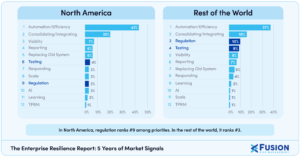
Trend 4: Regulators Are Compressing the Maturity Timeline Outside North America
The United States is all about freedom and flexibility, and its regulatory mandates reflect those values. Of course, there are still plenty of state and federal rules that American companies must follow, but worldwide, regulation tends to be more rigorous. That means that the pressure to achieve enterprise resilience may currently be higher in other regions than it is in North America.
Staying on the right side of cross-border regulations demands a robust scenario testing program, standardized data, and transparent board reporting. The solution isn’t to wait for new mandates before instituting changes. A reactive approach to compliance erodes stakeholder confidence and may increase costs in the long run.
Trend 5: Technology Availability Is Outpacing Cultural Adoption
In 2026, the quality of the technology available to risk management teams is no longer an issue. Fusion’s AI-powered enterprise resilience software makes it easy to integrate and visualize data once consigned to multiple disconnected systems, allowing resilience teams to gain insight into emergent threats at a moment’s notice.
Now, the problem is adoption. Resilience teams inherit their systems, and leaders are sometimes reluctant to evolve, even when ad hoc spreadsheets and static modeling tools fall short. But relying on manual business continuity planning keeps organizations stuck in the past, preventing them from moving up the maturity curve at the very moment when they need predictive capability most.
Essential Capabilities for a Competitive Advantage in 2026
In order to stay ahead in 2026, organizations must focus on building resilience for the long term. Companies that want to get ahead of the competition must shift from a focus on response and recovery to a focus on developing the following five capabilities.
AI-Driven Risk Modeling and Scenario Analysis
In the past, scenario testing involved creating a list of possible threats, manually modeling a handful of scenarios based on that list, and drawing conclusions from the results.
Unfortunately, this paradigm is rife with hidden risks. Leaders who choose the scenarios to test will likely focus on risks that are familiar and predictable. Manual modeling is so time-consuming that only a few scenarios will be built out. Conclusions will often rely on qualitative results rather than data and will lack rigor as a result.
AI tools for scenario planning and simulation can act as both impartial judges and expert number-crunchers during testing. Organizations can pinpoint novel but significant threats they may never have thought of before and model thousands of scenarios instantly. Fusion’s AI-driven data analysis capabilities allow teams to spot signals in the data that would otherwise have been lost in the noise.
Continuous Testing Built Into Daily Operations
In an organization with a programmatic approach to resilience, scenario testing typically takes place a few times a year, more for compliance purposes than because the results are used to drive day-to-day decision making. Despite the time and money that goes into testing, leadership continues to guide the company based on intuition and history rather than by the numbers.
Fusion’s enterprise resilience platform collects and models data in real time, allowing testing to run 24/7. Continuous testing makes it possible for leaders to stress-test operations against a wide range of potential impacts. This capability creates a culture of resilience, where conversations about risk are fully integrated into conversations about both company-wide strategy and daily team priorities.
Clear Visibility Into Third- and Fourth-Party Risk
In 2026, it’s becoming nearly impossible to understand an organization’s risk without understanding the risks facing the vendors and services it relies on. After all, threats like software outages and disruptions to supply chains don’t impact just one company: they can ripple through whole sectors of the economy with astonishing speed.
The solution is not isolation: it’s information. Being able to monitor third- and fourth-party risk in real time using business continuity solutions like Fusion allows an organization to prepare for and efficiently respond to these increasingly common disruptions.
Regulatory Alignment and Evidence Portability
As national and international regulations grow more numerous and more robust, companies must work toward being able to demonstrate compliance on demand. To do so, data must be fully visible and integrated, and priorities must be aligned on every level of the company hierarchy.
AI-driven systems like Fusion allow organizations to maintain maximum agility as regulatory expectations shift. Identifying and addressing compliance gaps and creating portable documentation of scenario analysis and incident evidence becomes far less tedious, which incentivizes business leaders to think about regulatory alignment all year round.
Adopting a proactive stance toward regulation prevents the costly headaches that can occur when an organization is always scrambling from audit to audit.
Board-Ready Data That’s Accurate, Trusted, and Available On Demand
These days, it feels like technologies, current events, and public opinion are constantly shifting underfoot. All that change can be especially nerve-wracking to boards, who are responsible for the long-term direction of the business. They want clarity, and nothing provides that better than cold, hard data.
Just as an AI-powered enterprise resilience framework can ease compliance challenges, it can also contribute to more impactful and reliable board reporting. Fusion’s custom dashboards provide on-demand insights that inject more quantitative rigor into both formal presentations and informal discussions about strategy, risks, and goals.
Stay Ahead of Shifting Trends With Fusion
In an era of volatility, it’s important to have partners you can rely on. Fusion’s AI-powered enterprise resilience platform can provide your organization with the capabilities you need to stay competitive: better data integration and visibility, more impactful scenario testing and reporting, and more efficient documentation, just to name a few.
Don’t get left behind in 2026. Let Fusion be your guide to building a more resilient organization. Close the growing maturity gap between your organization and those that have already embraced a proactive, holistic approach to resilience.
To learn more, read Fusion Risk Management’s Enterprise Resilience Report, watch our Continuity and Resilience Predictions webinar, or request a demo of Fusion today.
Authors