
Key Takeaways
- Operational resilience has evolved into a strategic imperative, enabling organizations to protect continuity, maintain customer trust, and sustain long-term performance amid growing disruption.
- Resilience must be embedded into the operating model, aligned to business strategy and owned cross-functionally, rather than treated as a compliance or siloed activity.
- Organizations that build resilience as a core capability gain confidence to adapt and innovate, strengthening reputation, stakeholder trust, and competitive advantage over time.
Disruptions dominate today’s headlines; cyber incidents, geopolitical shifts, supply chain instability, and extreme weather events are now part of the operating environment.
This raises an important question: if a major disruption hit your business, could you continue to serve your customers with confidence? If the answer isn’t a resounding yes, there may be an opportunity to strengthen your resilience posture.
The ability to do so was not the result of ad-hoc response; it reflects an operating model where resilience is embedded, not supplemental. Today, operational resilience is no longer about regulations or compliance or obligation; it’s a business imperative. In this environment, organizations that embed resilience into their operating model are better positioned to protect continuity and long-term performance.
What is Resilience?
Resilience is often conflated with regulatory adherence or crisis response. Yet many leaders recognize that true resilience extends well beyond these boundaries. It’s about continuity, adaptability of your organization, and agility under pressure.
Whether you’re in financial services, technology, healthcare or manufacturing, organizations must understand the interconnected ecosystem in which they operate. Resilience provides the foundation for organizations to not only withstand disruption but to maintain trust, sustain value, and enable long-term performance.
This means that resilience software should be aligned to your core business goals and your organization’s mission; not just to your risk appetite. The overarching theme is clear: resilience must be built into how an organization operates, rather than treated as an afterthought.
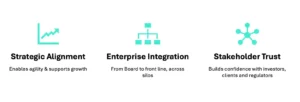
Three Strategic Levers for Resilience
1. Align Resilience to Strategic Goals
Resilience must be connected to core business objectives and mission, not limited to risk appetite statements. Consider Tesla during the global semiconductor shortage. While competitors halted production, Tesla adapted by rewriting software to utilize alternative chips. Similarly, during COVID-19, Walmart’s rapid pivot to e-commerce enabled continuity and growth. In both cases, resilience supported strategic agility.
2. Make Resilience Cross-Functional
Resilience cannot live in a risk, compliance, or IT silo. It depends on coordination across procurement, operations, technology, product, and customer-facing teams. Fragmented ownership leads to a fragmented response.
3. Enable Innovation Through Confidence
Resilience is no longer just defensive; it’s an enabler of innovation. When organizations are confident in their ability to recover, they can pursue innovation with greater clarity and control. The technology sector illustrates this well, where continuous testing, learning, and adaptation have created a culture where resilience and innovation reinforce each other.
Across these levers, stakeholders take notice. Investors value continuity, customers remain loyal to organizations that keep their commitments, and employees gravitate toward environments with stability and purpose. Resilience strengthens reputation, and reputation enables growth.
The Risk of Inaction
Many organizations are still treating resilience as a compliance exercise or a checklist. While regulatory adherence is important, checklists alone do not protect customer trust, safeguard brand equity, or guide decision-making during disruption. The risk lies in treating resilience as a form to complete rather than a capability to cultivate.
The Board Shift: A Call to Action
Boards and executive teams have a critical role in elevating resilience as a strategic priority. Key actions include:
- Make resilience part of strategic planning, not solely the audit cycle.
- Establish clear ownership and accountability at both the C-suite and board level.
- Invest in capabilities, culture, and cross-functional coordination.
- Measure more than recovery time; measure resilience maturity and adaptability.
Because when resilience is embedded in your organization’s DNA, it becomes a source of differentiation and a mindset advantage.

Embedding Resilience for the Long Term
Returning to the opening question: can your organization continue to operate with confidence during major disruption? Achieving that confidence requires moving beyond regulatory minimums and embedding resilience into how we plan, lead, grow, and compete.
The most resilient organizations are not merely navigating disruption. They are shaping their future through it. Contact us today to learn how Fusion can help you embed resilience across your organization and build the confidence to operate through whatever comes next.
Authors