
Key Takeaways
- Business continuity plans alone don’t prove readiness—only execution under real conditions does.
- Functional testing shifts validation from discussion to action, helping organizations uncover gaps and measure real performance.
- High-performing programs treat testing as a structured, continuous capability tied directly to business priorities.
Organizations today operate in an environment where disruption is constant and expectations for resilience continue to grow, with over 83% of organizations prioritizing exercising and testing response and recovery strategies as a core outcome of their programs.* Business continuity programs are no longer measured by the existence of plans, but by the ability to execute those plans effectively when disruption occurs.
Most organizations have invested heavily in documenting plans, defining roles, and conducting periodic exercises. Yet a persistent gap remains: confidence in execution.
The challenge is not whether a plan exists, but whether the organization can carry it out under real conditions.
The Role of Testing in Business Continuity
Testing is a critical component of any business continuity program. At its best, it provides a clear view of preparedness, reveals gaps, and helps teams improve over time. However, not all testing delivers the same value.
Traditional approaches, such as walkthroughs and tabletop exercises, play an important role in aligning stakeholders and validating assumptions. But they are inherently discussion-based. They confirm that teams understand the plan, not necessarily that they can execute it.
In practice, this often leads to:
- Limited visibility into how plans perform under real conditions
- Manual, inconsistent testing processes
- Difficulty tracking outcomes and driving follow-up actions
- Gaps in participation across business and technical teams
As a result, organizations can develop a false sense of readiness; one that is only challenged during an actual disruption.
What Functional Testing Adds
Functional testing addresses this gap by shifting the focus from discussion to execution.
Rather than asking whether a plan is understood, functional testing evaluates whether specific recovery strategies can be carried out by the right people, in the right sequence, within expected timeframes.
This type of testing focuses on:
- Validating critical components of recovery plans
- Measuring performance against defined objectives
- Identifying gaps that are not visible in discussion-based exercises
Functional testing does not replace other forms of testing. Instead, it complements them, providing a more complete view of readiness across understanding, coordination, and execution.
What Good Testing Looks Like
As organizations mature their programs, testing evolves from a periodic requirement into an ongoing capability. Effective testing programs typically share a few characteristics:
Structured and repeatable
Testing follows a defined process, making it easier to scale across teams and maintain consistency over time. Without this structure, testing is often ad hoc, varying in quality and making it difficult to compare results or demonstrate progress.
Connected to plans and strategy
Tests are directly tied to business continuity plans and recovery strategies, ensuring relevance and focus. When testing is disconnected, it can become a generic exercise that does not reflect real dependencies or critical business priorities.
Measurable
Clear objectives and outcomes, often including timing and completion metrics, allow organizations to assess performance and track improvement. Without measurable outcomes, it is difficult to determine whether a strategy is effective or where improvements are needed.
Action-oriented
Testing generates actionable insights, with issues identified, tracked, and resolved as part of a continuous improvement cycle. If insights are not captured and acted on, the same gaps persist—often only becoming visible during an actual disruption.
Inclusive of the business
Participation extends beyond continuity teams to include business and operational stakeholders, reflecting how disruption actually impacts the organization.
Limited participation can lead to plans that are not fully understood or executable by the teams responsible for carrying them out.
When these elements are in place, testing becomes more than validation, and instead, a driver of program maturity and organizational confidence. Without them, organizations risk maintaining plans that appear complete, but have not been proven to work in practice.
Functional Testing in Context
Functional testing is one part of a broader testing strategy. Cadence should be risk-based and aligned to critical processes, major plan changes, technology changes, organizational changes, and lessons learned from prior exercises.
At minimum, organizations should treat testing as a repeatable program, not a one-time annual event.
This approach reflects a broader shift toward continuous improvement, more structured review cycles, and stronger emphasis on training and exercising across resilience programs.
Improving Readiness Over Time
Testing shouldn’t be a one-time activity. Instead, when structured effectively, functional testing enables organizations to move toward a more continuous approach that supports ongoing validation and improvement.
Organizations can:
- Identify and address gaps earlier
- Track performance over time
- Strengthen coordination across teams
- Improve confidence in their ability to respond
Over time, this creates a more resilient organization; one where plans are continuously tested, refined, and proven.
As resilience programs mature, teams need tools that make testing more structured, measurable, and easier to operationalize across the business. That is especially important as organizations look to modernize traditional resilience practices and move beyond manual, one-off exercises.
Introducing Functional Testing for BCPs
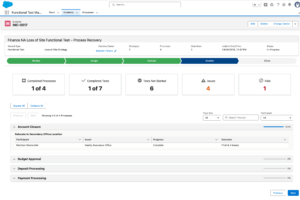
With the Spring 2026 release, Fusion is introducing Functional Testing for Business Continuity Plans (BCPs). This capability enhances existing exercise management by helping teams assign tasks, guide participants through execution, and capture outcomes in a more structured way.
Functional testing focuses on evaluating specific components of a business continuity plan by having participants perform assigned tasks in a controlled environment. This allows organizations to assess whether strategies can be executed within expected timeframes and conditions.
Supporting More Effective Testing and Execution
Functional Testing for BCPs is available as part of the Spring 2026 release, providing a more structured approach to validating and improving readiness. By connecting testing directly to plans and outcomes, organizations can strengthen execution, identify gaps earlier, and build greater confidence in their ability to respond to disruption.
To learn more, connect with your Fusion representative or request a demo.
* – BCI, Continuity and Resilience Report 2025, The Business Continuity Institute, 2025.
Authors